

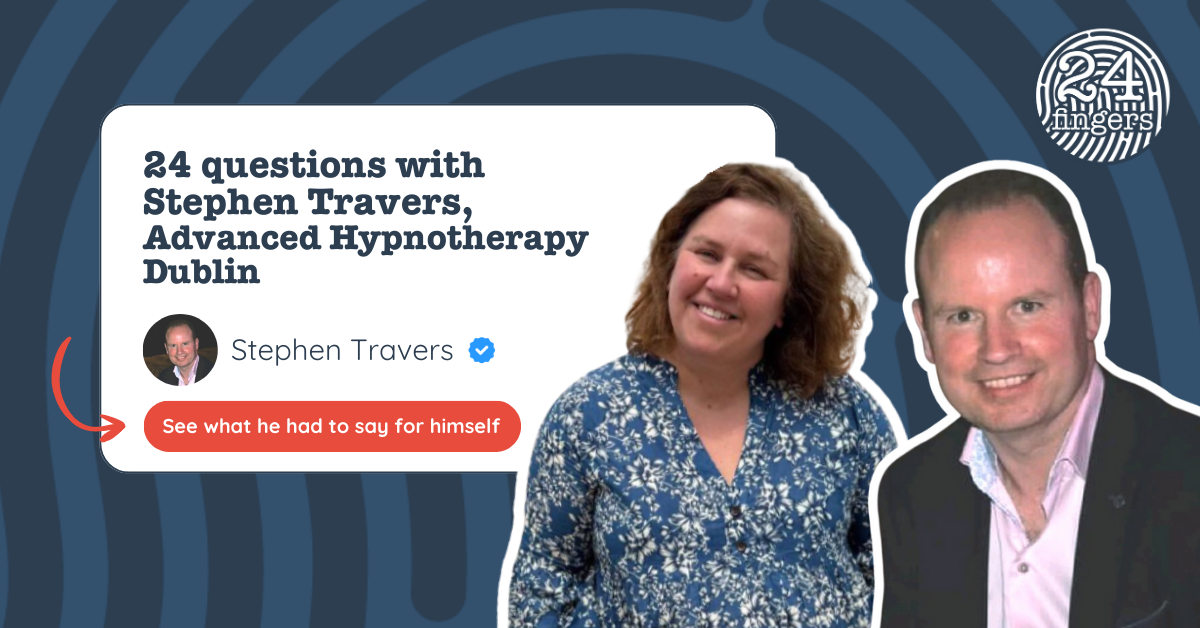
24 fingers: Good morning, good afternoon everybody. My name is Emma Goode. I’m the founder of digital marketing agency 24 fingers, and I’m delighted to be joined by Stephen Travers today for our 24 question series. Stephen is the founder of Advanced Hypnotherapy Dublin, and the person who’s trained more therapists in Havening Techniques than anyone in the world.
24 fingers: Hi, Stephen, how are you?
Stephen Travers: I’m good, thanks Emma. Set for this interview.
24 fingers: I hope so. I’m sure you are. So Stephen, I’m going to kick off if that’s cool with you. First of all, what’s your favourite word?
Stephen Travers: Transformational. Simply because of the work I do, it’s all about creating or achieving transformational results and outcomes for the people I work with. It’s one of the themes of my life as well and I love to achieve transformational results for people.
24 fingers: What gets you up in the morning?
Stephen Travers: My to-do list. My top things to get done during the day.
24 fingers: You’re quite an organised person I’d say, and so I should imagine that you plan the night before and then when you wake up, it’s all there, if I’m right?
Stephen Travers: Yes, I’ve got my simple notebook right there on the top; five to seven things to do and then when I wake up, the notebook is sitting there.
24 fingers: I knew that about you already. What do you truly, honestly think of social media?
Stephen Travers: I think it depends how you use it. It can be a fantastic tool or it can be extremely distracting. So from a business perspective, there’s so much amazing knowledge and information online, if you know where to look. At the same time, you can go down in rabbit holes or looking at Reels and YouTube clips of stuff that’s completely irrelevant, so it depends how you use it and what your intention is.
24 fingers: I guess it’s that thing of, you know when you open TikTok, am I going to spend an hour watching a cat dance, or am I actually going to go on social media to find something or check somebody out or interact?
Stephen Travers: Yes, that’s what I mean, it’s that double-edged sword, so I think it’s a new world problem and it’s certainly something to be vigilant and aware of. I do worry about the kids in the future, I must admit, but we’ll worry about that in ten years’ time.
24 fingers: So, Stephen, Kindles or books?
Stephen Travers: Books. Even though I use Kindles quite a bit because I have a library of books. I have boxes of books in storage from house moves I’ve done over the years and just from a practical perspective it’s mostly Kindle, but you can’t beat having a book in your hand, especially if you like underlining things and writing notes which I’m always a big fan of doing when I’m reading a book.
24 fingers: Yeah I agree, so when I left England a couple of weeks ago, I took one suitcase of clothes and one suitcase of books and then when I go back next month, I’ll be grabbing a different suitcase of books out. I don’t think you can beat them. So, Stephen, you’re a hypnotherapist among other things, but what do you think is the biggest challenge to your industry, if we said the wellness industry, right now?
Stephen Travers: I suppose it’s an obvious one, and many people are saying this in many different industries, but AI. Understanding where AI is, where it’s going, how do we use it, how is it going to affect the industry and therapists, etc and end users. So AI, I think, is the big one at the moment and the foreseeable future.
24 fingers: It’s a really good one. My little niece said to me last week, “Is ChatGPT your only friend?”. There is a huge amount of people going on to ChatGPT to get ChatGPT to organise their life and get feedback and kind of therapy, pseudo-therapy, and yeah, that is quite scary.
Stephen Travers: It depends. I believe that it’s the people who’ve got specialised knowledge and who can get results in a rapid and remarkable way; they are the therapists who are really the ones who are going to thrive because you can’t get that from an AI, but that’s always been the case. It’s just that technology and AI is probably going to accelerate that more. If you really want top-class results and you want it quickly and with someone who’s a specialist, you actually need to see someone face-to-face as opposed to having a chat with an AI-type bot or whatever you’re using.
24 fingers: I think it’s the same in my industry. So anybody can use ChatGPT to go on and say “give me 30 days of social media content” but I can see it, I can see the difference between a well-crafted caption that is relevant to a client’s tone and their objective to some generic output with em dashes, that’s my pet hate. So what did you want to be when you’re growing up?
Stephen Travers: Interestingly, an inventor is one of the first memories that comes to mind. And then secondly, I suppose when I look at my teenage years, I had an inkling about wanting to be some sort of a therapist strangely enough. So it’s only when I look back, it’s interesting how your inner voice, if you like, or your intuition, if you listen to it, can be guiding you.
24 fingers: You know, I 100% agree. I wanted to be a teacher when I was growing up. And now I am – I teach digital marketing. I couldn’t cope in a school because of the noise. And my son, bless him, was a very quiet baby. The noise would drive me insane in the school, but actually it came true in a better way than I could’ve imagined. So I agree with you. What led you to your current career?
Stephen Travers: Personal experience, as in, I had a panic attack one day. At the time, I was in my early twenties and I was working in the area of sales and marketing because I loved all the psychology behind it. Because of working in the area of sales and marketing I was actually quite aware of things like NLP, communication, even hypnosis, because I was reading all the sales and business stuff, which is all around mindset.
So I went off and decided to train with the Institute of Clinical Hypnotherapy and Psychotherapy in Ireland to resolve my own issues and that was it. That was a game-changing moment, because I really enjoyed helping other people and of course all the psychology behind it, so there was a blessing in disguise to the crisis.
24 fingers: I know you and when I talk to your clients, invariably without fail, they always say to me how empathetic you are and I should imagine what an early adopter you were when you started because not many people were thinking in NLP even in sales, they were like, you know, how many calls can I make and how can I shut someone down and all of that and you clearly were coming from a much more heart-centred approach.
Stephen Travers: Yes, absolutely. I was quite lucky with the type of companies I was involved with, which always was really focused on communication skills as well. Of course, it’s all about the numbers, but especially good sales and marketing, it’s all about having really good communication skills. It’s about helping people and serving people ultimately – that’s even where the word sales comes from, to serve.
24 fingers: I didn’t know that. Heard it here first. So your favourite word was transformation. Can you use it in a sentence for us please?
Stephen Travers: I love achieving transformational results for my clients.
24 fingers: Excellent. Now this one might make you work a bit for a Monday morning. Can you make it rhyme?
Stephen Travers: To be transformational is to be inspirational.
24 fingers: Well done, excellent. So what advice would you give to your younger self, the one that wanted to be an inventor and a therapist?
Stephen Travers: I would say, listen more to your inner voice and your intuition. Trust yourself more, listen, tune into it more. Trust it.
24 fingers: There it is. I think maybe society can dull our trust of our own intuition and other people’s opinions.
Stephen Travers: There’s a lot of distractions out there. People telling us what we should be doing, what we shouldn’t be doing. Especially when you’re young, be it from parents and teachers, but as I said, listening to that inner voice can be certainly a North Star or at least the guide to keep you moving in a certain direction or at least, to explore it. Getting older I do it a lot more. My sister was talking about this other day. I think as you get older, you’re a lot more certain of your own conviction or should we say, your deepest kind of dreams, thoughts, desires, et cetera.
24 fingers: It can certainly come with experience. Trial and error sometimes as well.
Stephen Travers: Oh, I was going to say, there’s been a lot of that, trust me.
24 fingers: So, Stephen, you’ve had a great career so far. What’s the best thing anyone’s ever done for you?
Stephen Travers: Well, when I look back, it’s people, especially when I was younger, who gave me opportunities, like my first job, mentors along the way. So I would say probably my very first proper job in my early 20s. I ended up working with one of the top business people in my county and even though it was difficult because this person was a hard-nosed business guy, I learned so much. So it’s just people who gave me opportunities when I was younger.
24 fingers: I think in my early 20s, I spent most of my career in the pub actually, so while you were learning to absorb and building yourself, I was probably under a table somewhere in London. And tell us what’s been your career-defining moment so far? You might not have had it yet.
Stephen Travers: There’s been many. I suppose one of them would be when I came across Havening and I started training in it, using Havening and coming across it back in 2012 because of the rapid and extraordinary results it was producing for my clients with anxiety-based disorders such as panic attacks, PTSD, fears, phobias, and then blending that as well with hypnotherapy.
So that’d definitely be one because I ended up training so many other therapists and health professionals. That was certainly a defining moment per se.
24 fingers: I think you’ve been a little bit modest there, Stephen, like you’re the world-class trainer and expert, but for those listeners that haven’t heard of Havening Techniques before, can you just give us a brief outline of what Havening Techniques is?
Stephen Travers: Yes, it’s a psychosensory therapy for the resolution of trauma and anxiety-based disorders. So when we say psychosensory, we mean as well, we use sensory touch where we stroke the arms, palms and face and we use psychological distraction techniques. So it’s very good at delinking or removing the emotional and physical stress from the traumatic memories or things that trigger anxiety within just minutes and it can completely and permanently remove it. It’ll actually change what’s happening in the brain; it switches off that fight or flight reaction from the nervous system.
So people really get to experience remarkable, tangible results within the actual sessions where something that was really traumatic or really upsetting or stressing them is significantly reduced, if not, completely disappears.
24 fingers: I was thinking then if somebody’s suffering really badly and might have suffered for years, the joy and the respite of having something completely transformed within an hour session is incredible as opposed to going over and over the same thing for potentially years and years. The difference you must have made to many people’s lives – the quality of living – they can now be free of things like panic attacks which are pretty scary and traumatic. I’ve had them and you don’t quite know what’s going on when you have the first one, it’s a really scary experience.
Stephen Travers: Yes and that’s the main reason why I do what I do because I enjoy achieving those results with people and seeing people experience those transformations. Again, it’s like someone having a physical pain for so long, then you’re removing and taking away that pain. I love this.
24 fingers: And if I’m right, Paul McKenna is a huge advocate of Havening if I’m right.
Stephen Travers: Yes, he would be one of the most famous advocates of Havening, that’s correct. And then there’s others as well, like Dr. Gabor Maté and Dr. Daniel Amen. There’s many.
24 fingers: So, we’ve heard a little bit about your career and the people that have helped you on the way. If you won a big award, who would you thank?
Stephen Travers: It’s such an interesting question and it might seem a bit arrogant to say but I would say myself simply because I see that there are opportunities put in front of people and they don’t always take them. At the end of the day, you have to take the action to make things happen in your life. Every door that’s opens up, ultimately, you still have to get up and walk through and sometimes that can be scary and it can stretch outside your comfort zone. It’s like joining a gym. You know joining the gym doesn’t get you the results – you’re the one who has to get up every day and go to the gym and put the work in.
24 fingers: It starts with me as someone once said. It starts with putting your trainers on. I agree. I love that. So, Stephen, I’m getting to know you more and more as the years go by, but you’re a very organised, disciplined person. Can you give us a time saver of the day, please?
Stephen Travers: It goes back to what we talked about earlier, which is just have a simple list of your top priority actions of things you want to get done that are most important to you. And I’d say keep it small, your top five things, and aim to get them done every day. And if you don’t get them all done, review why, and then keep refining what you’re doing.
24 fingers: Very good, very good. So where do you see your industry in 24 months?
Stephen Travers: I really wish I had a crystal ball on that one. I think as we know, things are moving very fast. I think the people who can position themselves as experts who are very specialised in what they do and probably more importantly, can demonstrate consistent results are the ones who are going to come out on top and the people who embrace the technology as well.
24 fingers: I went to a conference a few months ago and there were nine-year-olds developing these apps and I came rushing home and I was like, if a nine-year-old isn’t in touch with this new technology, there’s an issue because the quality and the excellence of these children just blew my mind and I was thinking, if they’re doing that at nine… So where were you 24 months ago?
Stephen Travers: I was working with my clients. I’ve been doing this almost two decades plus, come to think of it. So working with my clients and running my trainings, that’s what I was doing.
24 fingers: You’re a big believer in that if somebody’s developing a practice, then you need to treat it like a business, that’s a big thing for you, isn’t it? So when you work with your therapist clients in helping them develop their own practices, you’re really encouraging them to think strategically, not just about kind of filling a session, but to treat it like a business and invest their time, effort and money into it?
Stephen Travers: Absolutely. I think that is one of the biggest challenges in my industry as well, is that there are many therapists who are very good at what they do, and many of them can get good, even great results with people. But often I see that some of them struggle at actually having a sustainable, thriving practice. And it’s often because they’re not treating it as a business. That’s the mindset shift, first of all. And then the strategy is just coming back to three simple things. It’s being able to get good to great results for people, be able to turn your enquiries into actual clients. That’s the client acquisition, the phone consultation process, and then having a way of generating enquiries regularly, that’s your marketing, your organic marketing and your paid for marketing.
So a bit like a combination lock. If you get those three things in place, it opens up that thriving practice very, very quickly actually.
24 fingers: I’m doing some work at the moment on my CRM and I’ve been looking back over the last five years and the amount of businesses that have gone bust in those five years is really sad. Every time I go to a website and it’s down, I get really upset and I think that a sustainable, scalable business model is really important. Like when I started my business, I thought it’d be so linear, I thought it’d be, you know, profit month on month and no peaks and troughs. Now I know differently. But to get those pillars of actual kind of discipline in place, I wish I’d done that 11 years ago, I should have known you 11 years ago, Stephen. So what’s an interesting fact about your company?
Stephen Travers: I suppose that I’ve trained more therapists and health professionals in the world in Havening than anyone.
24 fingers: So if you could have a 24-minute Zoom chat with anyone living or dead, who would it be?
Stephen Travers: That’s an interesting one. I would say Dr. Andrew Huberman. He’s a neuroscientific researcher and I’d love to talk to him actually, about Havening and talk to him about the neuroscience because I think he’d find it very fascinating and I think it would probably make a great topic for his podcast.
24 fingers: What’s one word you’d like people to describe you with?
Stephen Travers: I’d say something like empowering, in terms of empowering other people, empowering them in their thinking, feeling, acting and for them to feel empowered or more empowered after they work with me. It’s one of the main things I want to impart to people.
24 fingers: My sister’s working with somebody over here, a wellness expert, and he said my job is to get you to be able to walk into the gym and pick up any weight or go to any machine and be able to do it for yourself, rather than being reliant on a PT constantly. I’d not heard that approach before. Matt Marney, if anybody is in Dubai looking for a corporate wellness expert. That really impressed me because he wasn’t thinking about how many sessions can I get this person to keep booking in and in and in, he was thinking, how can I teach you to fish? Is that the right expression?
Stephen Travers: It’s the idea, give a man a fish or a woman, he eats for a day, teach a man or woman how to fish, they eat for a lifetime.
24 fingers: I really like that, really refreshing. So would you like to take a selfie for us? Let me just do a screenshot. And we’re nearly done. So Stephen, what’s your favourite social media campaign?
Stephen Travers: I would say it’s the free introduction events to various things. I think they work very well. I often attend them. Then you can make a decision if you want to go deeper with them. So I think they work really well.
24 fingers: You’ve set me up very nicely. Here’s my Eventbrite for digital marketing events. Thank you Stephen for allowing me to do that plug. What’s one quote that just defines your work ethic?
Stephen Travers: Once again, there would be many, I suppose, but I would say, do what you love, love what you do. I think that’s very important, because it doesn’t make it feel so much like work, so if you can find things that you love doing or fall in love with doing them more, it makes life a lot easier. And you need that to be sustainable, and if you want to become really great at what you do, that you’re doing something you love and that you enjoy.
24 fingers: Definitely, I work a lot, as you know, but this isn’t work for me. It’s an absolute joy and a privilege and a passion. And even if I won 2 billion dollars, I would still do this, because I love it. And I really love seeing somebody be perhaps nervous about social media to go on and be on camera or do a video or post for the first time. It really brings me so much joy. And that’s not about how much they’ve spent with me, how much they’ve spent on Facebook advertising, it’s just that real high five moment where I’ve seen somebody go out of their comfort zone especially on social media which is, you know, it’s a hard place and if somebody’s less than confident about being visible, that first step out, I love it. What’s been the best part of your day?
Stephen Travers: It’s only 11. Often the best part of my day is when I work with a client and I achieve one of those remarkable results we talked about. Someone comes in with trauma, maybe they’ve had it for decades. And then in the space of sometimes just minutes, we completely clear it and the client is amazed. We bring them back to the memory or the trigger and the stress is completely gone from it. To experience that with someone on a very regular basis, practically nearly every day, that’s my favourite part of a day. I’ve been doing this nearly 20 years and that still gives me a dopamine hit. That’s a really good feeling; that mild euphoria when that happens.
24 fingers: I love it. I watched one of your trainings and I got goose bumps when I saw the lady say before in terms of pain level or stress level that she was at nine and now she’s at zero. That was just so impactful. I’ve seen it first-hand which leads me on to if you’ve got anything to plug.
Stephen Travers: There’s probably many things, but I would say for the general public, I hav a complimentary phone consultation where I take a deep dive where I can really pinpoint and identify what’s causing your presenting problems, be it overcoming anxiety, insomnia, some sort of phobia, PTSD, or any type of stress symptoms you might have. I do a 30-minute deep dive and then I can give you informed feedback or a presentation on how we can actually resolve that. So that’s one option. Of course, there’s the Havening training events and they’re always happening at least a few times a year.
24 fingers: Well, if I’ve done my job properly you’ll see that on Facebook anyway. Well, Stephen, you’ve been an absolute pleasure. Thank you so much for your time. And if any viewers would like to get in touch with Stephen, check out the links in the blog and in comments. Brilliant. Thank you again.
Stephen Travers: Thank you, Emma. My pleasure.
You can connect with Stephen on YouTube, LinkedIn and Facebook.
